Showing posts with label 1700's. Show all posts

Sunday, 3 November 2019

1770s Stays: Part 2

The Stays are finally complete!
Part One is here
I began the finishing touches by strengthening the seams, covering them with some cotton tape on the inside and some ribbon on the outside.

Saturday, 8 June 2019

1770s Stays Part One


I realised today that this blog has been neglected for a while, so it's time to catch up and hopefully get a few posts written up this weekend!

I decided a while ago that I wanted to make some 18th century clothing for myself. As the 1770s is a very versatile period with lots of  new fashions and changing styles I felt it would be the best place to start. I've covered a little of the history behind 1770s stays as well as how I made my first pair here


The Pattern I used was the 1770s stays from Corsets and Crinolines

Sunday, 6 May 2018

Project: Polonaise- Part 12, Finale

So I only just realised that I never got round to publishing this post, but here is the final instalment of the polonaise project which I completed almost a whole year ago, eek!

Once the costumes, coursework and dissertations were all completed the final part of my classes grade was a show and exhibition of our work. This meant a stressful week of rehearsals, decorating the theatre and organising shelves, plinths and mannequins for displaying our work.

My section of the exhibition, my other two costumes are Papageno from The Magic Flute by Mozart (my design project) and Aravis from The Horse and His Boy by C.S Lewis (interpreted for stage from the book illustration by Pauline Baynes)

Sunday, 25 March 2018

Project: Polonaise- Part 11, The Gown

I finally got round to writing this post, I'm so sorry it took so long! But it's time to talk about The Gown!

Friday, 16 February 2018

Project: Polonaise- Part 10, The Jewellery


This project would not have felt complete without a bit of bling! The fashion plate I was re-creating showed the figure wearing a chatelaine, bracelet and necklace with gold colour schemes.


Sunday, 4 February 2018

Project: Polonaise- Part 9, The Hat

I'm going to start off by saying that the hat was probably the least historically accurate part of this entire project. Having said that I do still really like it (and it helps to cover up the wig).

Historically most 18th century caps would be muslin or linen that was stiffened with starch. However this would mean that the hat would require almost constant reshaping practically every time it was worn. In order to avoid this I decided to support the hat with a crown of buckram.

The hat from the fashion plate I was re-creating

Monday, 22 January 2018

Project: Polonaise- Part 8, The Shoes

It took a while for me to decide what to do about the shoes. I spent a long time on the American Duchess website fawning over their wonderful creations and wishing I could justify spending a pretty big slice of my budget on them. Unfortunately my model had quite large feet which would have made getting the right size difficult. This, added to the shipping costs and customs charges I would have had to pay, plus the fact that I was on a deadline meant I had to look for other options.
The look I was aiming for

 Whilst scrolling through Pinterest in a fit of stress and worry I came across two different blog posts by ladyannabelle-of-didmarton and  couturemayah were they demonstrated how to turn an ordinary pair of high heels into 18th century style shoes! I was saved! I gathered together shoes, epoxy putty and fabric glue and got to work...

Sunday, 21 January 2018

Project: Polonaise- Part 7, The Wig

As my model had dyed, bright coloured hair making a wig for the costume was very important as a way to keep the authenticity. I had made a wig in a previous Year of my course which I actually felt ended up looking much nicer.

The Second Year Wig

The Third Year Wig on my model

Tuesday, 9 January 2018

Project: Polonaise- Part 6, The Petticoat

During the 1700's women would wear quilted petticoats in order to smooth out their silhouette over the false rump or panniers. This was also a sign of status, earlier in the century rich, fashionable women would sometimes wear their gowns with a visible petticoat (as in the picture below) and so they were often made of silk. As the character for my polonaise costume was a rich lady I decided that I too had to make the petticoat out of silk.


Saturday, 6 January 2018

Project: Polonaise- Part 5, The False Rump

In the 1770's and 80's the emphasis moved backwards from the hips and the panniers that everyone associates with Marie Antoinette were discarded in favour of false rumps. These 'rumps' would be stuffed with horsehair of made from cork and came in various shapes and sizes as can be seen in the caricature 'The Bum Shop' (R.Rushworth 1785).


Tuesday, 2 January 2018

Project: Polonaise- Part 4, The Pockets and Garters

This part of the underpinnings was one of my favourite to construct. During the eighteenth century women would wear sort of bag shaped pockets around their waists and the other layers of clothing would have slits cut into them so they could be reached. Garters would be worn to keep stockings up. Both of these items would often be embroidered and I decided to make them to match. My main source of inspiration was a pair of pockets from the Snowshill Collection and two pairs of garters from the V and A that I got to sketch during my visit.

Pockets from the Snowshilll Colllection

Friday, 29 December 2017

Project: Polonaise- Part 3, The Stays

The next stage of the project was the stays, which is essentially the eighteenth century name for a corset. The Stays worn during this period were designed to elongate the wearer’s silhouette. The corsets typically had a low Scooped bust-line to accommodate the fashionable low necklines of the gowns and were pulled together at the shoulder blades to give the wearer a more upright posture. I decided to make my stays using the 1780's pattern from Nora Waugh's 'Corsets and Crinolines' and also took inspiration from the pair below which is from the V and A that I got to see personally during a visit. I will say this is definitely not the be all and end all of how to make a pair of stays. There are A LOT of things on this project that I would do differently given a second chance but I hope this post is helpful anyway.


Thursday, 28 December 2017

Project: Polonaise Part 2, The Shift


A Shift or Chemise (They seem to have been used interchangeably) is the base layer of any pre-19th century European outfit. I chose to make mine out of linen, as the vast majority seem to have been at the time due to cotton still being a luxury item. The majority of this garment was stitched on the machine (as per our course guidelines) with finishing done by hand.

Project: Polonaise - Part 1, Reserch

So here's the beginnings of the details I promised about how I made my Polonaise Costume. As you can imagine I did a TON of research for this project but here's an overview of the important stuff from a cannibalised Statement of Intent and a Historical Fashion Overview from my degree folder.

  A Polonaise was a style of dress popular in the Eighteenth century as an informal style that grew from the habit many women had of tucking their expensive overskirts into their pocket slashes during walks to stop the fabric from trailing in the mud as you can see in the picture below which is from the Kyoto Costume Institute.


Monday, 28 August 2017

Hello!

Hello and welcome to my blog! I'm a recently graduated Historical Costume student with a great love for sewing and plan to use this blog as a place to document my creations. I especially love the Eighteenth and early Nineteenth Centuries so expect lots of posts from those time periods though other eras will crop up from time to time.

To start with here are some photos of a few of the costumes I made during the three years of my degree. To see more visit my Facebook page Isabel Innes Costume.


 My third Year Historical project was a polonaise gown from 1780 reproduced from this fashion plate. I also created all of the underwear to go with it including a quilted petticoat and embroidered pockets. I will make another post on this costume going into more detail.


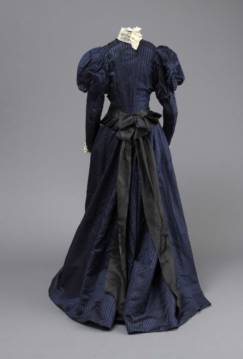
 For my second year historical project we had to make 1890's walking dresses. It is based on a dress from the Hull Museums Collections that was designed by Madame Clapham (below). She was widely known as Hull's most famous dressmaker and her clientele included Queen Maud of Norway.

I found it very difficult to find striped fabric in the colours of the original dress so I compromised with plain blue taffeta with diamond tucks that I found at the Harrogate Knitting and Stitching Show (If you haven't been, and can get there, go! It's amazing!).

Then because I didn't have enough work I decided to make the lace for the sleeve cuffs. I know... I'm completely crazy this thing had an actual deadline and I'm sat there weaving threads together like a madwoman. I'm just happy it all turned out ok in the end.


 In first Year we were given the challenge of creating a regency dress and underpinnings. This was the first time that I had ever made a corset and I found it to be a very enjoyable challenge with all the quilting and cording. The dress itself was based on one from The Snowshill Collection though I simplified the embroidery on the sleeves, neckline and waistline due to time constraints. The dress was made from white muslin and lined with cotton lawn and the bonnet was covered with the same stuff.


1790s short stays (and a petticoat)

In January I made a decision to begin a 1790's ensemble. I originally wrote the majority of this post in February and have only just got...